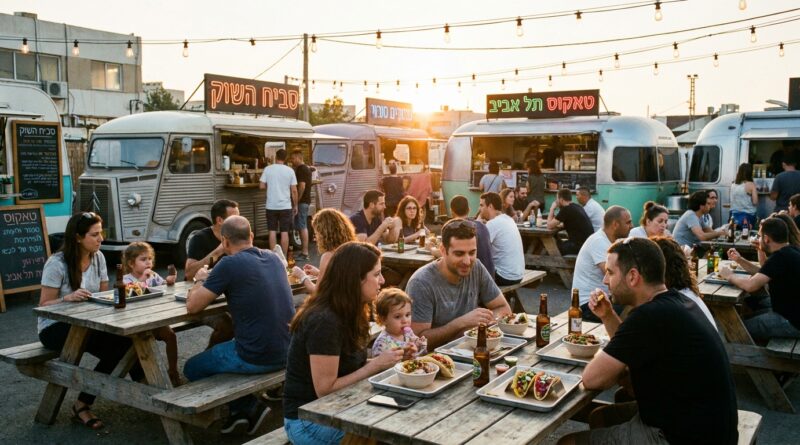
Israel’s New Food-Truck Courts: The Open-Air Micro-Restaurants Changing How We Eat Out
You can feel the trap the minute you try to plan one good night out. Every list sends you to the same chef counters, the same polished tasting menus, the same places with a two-hour wait and prices that make you check your bank app twice. If you are visiting Israel, or even just trying to eat smarter in your own city, that gets old fast. The better story right now is happening outside, often under string lights, at the new food-truck courts popping up in Israeli cities. These open-air micro-restaurants are looser, cheaper and usually far more fun. Best of all, they let you taste several kitchens in one sitting instead of betting your whole evening on one overhyped reservation. If your search for a new food truck court Tel Aviv has mostly brought up crowded old favorites, it is worth looking past the obvious. Some of the most exciting meals now come from places that still feel half-hidden, in the best way.
⚡ In a Hurry? Key Takeaways
- Israel’s new food-truck courts offer one of the best ways to eat well right now without pricey reservations or long formal dinners.
- Order light from two or three trucks instead of one big meal. Build a progressive dinner with one snack, one main and one dessert.
- Go early for easier parking and shorter lines, and always check Instagram stories or local pages since hours can shift.
Why these food-truck courts matter now
For years, “eating out” in Israel meant choosing between a sit-down restaurant, a market stall or a quick falafel on the run. That is changing. Food-truck courts sit in the middle. They feel casual like street food, but the cooking is often serious. In many cases, chefs use them to test ideas before opening a full restaurant, or to serve a stripped-down version of their best dishes at friendlier prices.
That is why this trend matters. You get creativity without the ceremony. You get local ingredients without the lecture. You get a very Israeli mix of grilled meats, sabich twists, seafood buns, craft desserts, natural wine and loud conversations at neighboring tables.
For travelers, that is gold. One stop can give you a wider taste of the city than three separate bookings.
What a “food-truck court” actually looks like in Israel
Do not picture a lonely truck in a parking lot. The newer courts are more like compact outdoor dining hubs. Think shaded seating, a small bar, a few curated trucks, music, families with kids, couples on dates and a late-night crowd drifting in after the beach or a concert.
Some are in redeveloped industrial corners. Some are attached to markets or cultural spaces. Some feel almost temporary, which is part of the charm. You may sit on metal chairs with a tray of tacos and then finish with malabi from a truck ten steps away.
That flexibility is the whole point. You are not locked into one menu.
How to find a new food truck court Tel Aviv visitors usually miss
Google Maps helps, but it is not enough. TikTok is fun, but once a place goes viral, the line is often longer than the meal is memorable. If you want the newer spots, use a few simple filters.
1. Search by neighborhood, not just by dish
Instead of searching only for “best burger” or “best pita,” try looking by area. Florentin edges, south Tel Aviv warehouse zones, Jaffa-adjacent cultural lots and mixed-use entertainment spaces often hide newer courts before travel sites catch up.
2. Check Instagram before you leave
Many of these places update hours, truck lineups and pop-up events on social media first. A court may have six trucks on Thursday and four on Sunday. One truck may be sold out by 9 p.m. That is normal.
3. Follow local food writers, not just tourist creators
Tourist videos often repeat the same old places. Local coverage is usually better for openings, chef residencies and short-run collaborations.
That same “look beyond the obvious” habit is useful outside Tel Aviv too. If you are widening your trip, read Israel’s New Borderland Comeback Kitchens: The Northern Restaurants Quietly Reopening Against All Odds. It is a good reminder that the country’s most interesting food stories are not always in the loudest districts.
What to order for the best value
The easiest mistake at a truck court is treating it like a normal restaurant. You walk up hungry, order the biggest thing at the first truck, and then realize too late that the dessert line is amazing and the grill truck next door smells even better.
Do this instead.
Start with a splitable first bite
Order one thing to share. A small pita. A skewer. A fried starter. A taco plate. This lets you settle in without spending your whole budget in five minutes.
Choose one “main event” truck
After that first bite, look around once more. Which truck has the deepest line of locals? Which one seems to have the sharpest menu? Pick one place for your main. Usually that means grilled fish, a standout sandwich, shawarma, handmade pasta, modern Iraqi food, Yemenite-inspired breads or a seasonal vegetable plate with serious technique.
Always save room for a local-style finish
At the best courts, dessert is not an afterthought. Malabi, soft serve with tahini caramel, pistachio pastries, kanafeh cups and creative takes on rugelach or babka often show up in truck form. End there, not with another heavy savory dish.
The progressive dinner strategy that works
If you want maximum flavor per shekel, build the night in three rounds.
Round 1: Snack
Spend lightly. Share one dish. Think 25 to 45 NIS total.
Round 2: Main
Pick your strongest truck and spend here. Think 45 to 75 NIS per person, depending on seafood, meat or portion size.
Round 3: Sweet or drink
Finish with dessert, local beer or a glass of wine. Think 20 to 40 NIS.
That keeps the whole evening flexible and usually cheaper than one trendy reservation, especially in Tel Aviv.
What makes these places feel more local
It is not just the food. It is the pace. At many truck courts, people stay longer, share more and mix groups more easily. Families can feed picky kids. Couples can try four different things without negotiating one menu. Friends can arrive at different times and still fit in.
You also get a more current snapshot of what Israeli cooking looks like right now. Not what was cool two years ago. Right now. Chefs are mixing regional traditions with faster formats. You may see Druze labneh in one truck, Japanese-influenced fish in another, and a full-on bakery cart doing rose water cookies nearby. It feels alive because it is.
Practical tips before you go
Go early if you hate lines
Arrive around opening or just before the main dinner rush. In many places, that means a smoother first hour and a better shot at the full menu.
Check seating reality
Some courts have lots of tables. Some do not. If you are with a group, send one person to hold seats while others order.
Bring small patience
Not big patience. Small patience. These places can feel improvised. A truck may run out of one item. Another may be cashless. One may move fast while the next is slow. That is normal. Roll with it.
Dress for outdoors
Simple but easy to forget. Heat, wind and uneven surfaces are part of the package.
Who will love this most
This style of eating is perfect for travelers who want variety, couples who cannot get last-minute reservations, families trying to keep costs in line and locals who are tired of paying “special occasion” prices for a Tuesday night dinner.
It is also great for cautious eaters in a group. If one person wants grilled meat, another wants vegetarian food and someone else just wants fries and dessert, everybody wins.
At a Glance: Comparison
| Feature/Aspect | Details | Verdict |
|---|---|---|
| Price | Usually easier on the wallet than chef restaurants, especially if you share and pace your ordering. | Best value for trying several dishes in one night. |
| Atmosphere | Open-air, social, casual and often more local-feeling than formal dining rooms. | Great for relaxed evenings and group dining. |
| Planning effort | Less reservation stress, but you do need to check hours, truck lineup and crowd levels. | Low-pressure, but a quick pre-check makes a big difference. |
Conclusion
The smartest meal in Israel right now may not be behind a host stand at all. It may be in a courtyard, on a folding tray, with music in the background and three different dishes in front of you. That is why this new wave matters. Prices are high, reservations are tight and most people still want food that feels local, not copied from the same tired list. A good food-truck court solves that. You spend less, taste more and build your own version of a night out. If you are hunting for a new food truck court Tel Aviv style, skip the reflex to book the buzziest table in town. Try a progressive dinner instead. One snack, one main, one dessert. It is a realistic, budget-friendly way to taste the best of modern Israeli cooking before the big sites finally catch on.